Why Your House Will Shine in Today’s Market
October 29, 2024
Even though interest rates are lower than last year, the rates are still keeping buyers from buying a house unless they really like it a lot. There are more homes available for sale than there were at this time last year, there are more buyers than there are good houses to to keep up with the demand. So, know that if you’ve got moving on your mind, your house needs to be prepped and really stand out to make a buyer say “I want to buy it!” 
There are several key reasons why there aren’t enough homes to go around and understanding them will help you see why the market is working in your favor if you’re ready to make a move.
What’s Causing the Shortage?
1. Underproduction of Homes: For years, the industry hasn’t built enough homes to keep up with demand. As Zillow explains:
“In 2022, 1.4 million homes were built — at the time, the best year for home construction since the early stages of the Great Recession. However, the number of U.S. families increased by 1.8 million that year, meaning  the country did not even build enough to make a place for the new families, let alone begin chipping away at the deficit that has hampered housing affordability for more than a decade .”
2. Rising Costs: Building materials, labor shortages, and supply chain disruptions caused by the pandemic have all made it harder and more expensive to build homes. This can either limit or stop new home construction in some areas.
3. Regional Imbalances: Some markets are more affected by the shortage of homes than others. Popular and more desirable areas have more people moving in faster than new homes can be built. The number of new building permits issued doesn’t always keep pace with job growth in these regions, and that leads to even tighter markets and higher prices.
How Big Is the Problem?
According to estimates from Real Estate News, the U.S. is facing a housing shortfall of roughly 3.3 million homes, based on an average of several expert insights (see graph below):
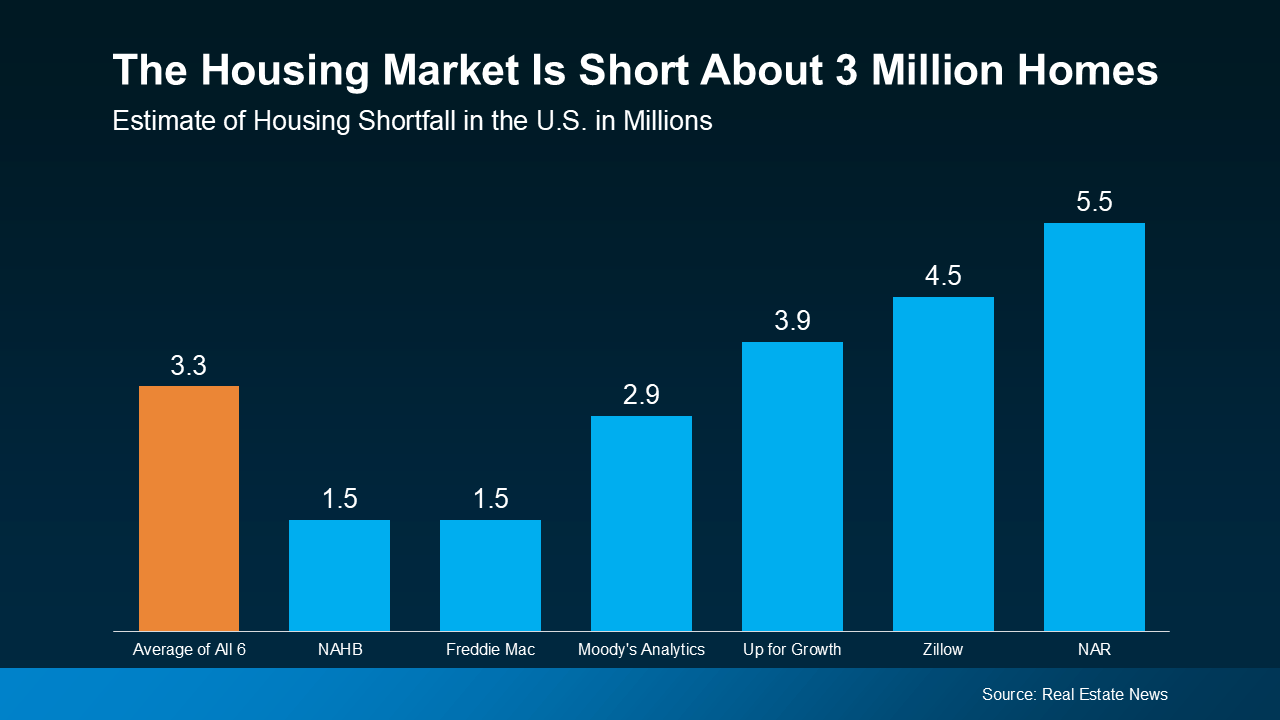
This shows there’s a significant number of homes that need to be built just to meet current demand from buyers. But what about future demand?

According to John Burns Research and Consulting (JBREC), over the next 10 years, the U.S. will need about 18 million new homes to meet projected demand, including homes for new households, second homes, and replacements for aging or unusable homes.

So, even though more homes are on the market compared to last year, there still aren’t enough of them to go around. This is where you can really win if you’re ready to sell your house.


What You Need To Remember


If you’re thinking about selling, the shortage of homes for sale means your house is likely to get some serious attention from buyers. It’ll take years to climb out of this inventory deficit, and the market is still very tight. So, when buyers are competing for relatively few homes like they are right now, that creates more interest in the houses that are on the market, putting upward pressure on prices and ultimately working in your favor.

And since every market is different, it’s important to work with a real estate agent who understands local trends. They can help you price your house right and create a strategy to attract the right buyers.


Bottom Line


While there are more homes for sale than there were at this time last year, the buyers are still picky and need to fall in love with the house to want to make it home. This puts you in the driver’s seat as a seller, but don’t get too demanding as the buyers will not over pay. We need to price your house appropriately to get it sold. Let’s connect so you have someone who can help you take advantage of today’s market.


January 17, 2026
Wondering what to expect from the housing market in 2026? You’re not the only one. For the past few years, affordability has been the biggest barrier standing between most people and their next move. And a lot of buyers and sellers have been holding their breath waiting for things to get better. The good news? It’s finally happening. In 2025, affordability was the best it’s been in 3 years. And experts agree the momentum will keep going in 2026. And that’s based on their analysis of the key factors shaping the housing market in the year ahead: mortgage rates, inventory, and home prices. Lower Mortgage Rates Are Already Here Mortgage rates have already come down from their peak. By some counts, they dropped by almost a full percentage point over the course of the last year. And that’s a big deal, even if it doesn’t sound like it. But how low will they go? And should you wait for them to come down more? Here’s your answer. Forecasts suggest they’ll stay pretty much where they are now and hover in the low 6% range throughout 2026 ( see graph below ): 
January 13, 2026
Would-be homebuyers aren’t sitting on the sidelines because they don’t want to buy. They’re sitting out because they think they can’t . And sometimes, it’s their credit score that’s holding them back. According to a Bankrate survey , 2 out of every 5 (42%) Americans believe you need excellent credit to qualify for a mortgage . That may be why, when renters are asked why they don’t own yet, “ my credit isn’t good enough ” comes up often. Maybe you’re in the same boat. You look at your score, see it’s not where you want it to be, and assume buying your first place just isn’t realistic right now. But here’s what you need to know. Even though a lot of people assume you need flawless credit to buy a house, that’s not necessarily the case. You Don’t Need Perfect Credit To Buy a Home So, where’s this myth come from? Part of the confusion stems from the fact that the typical homebuyer today does have a fairly strong credit score. In fact, according to data from the NY Fed, the median credit score for all buyers is 775. But that doesn’t mean you need a score that high to qualify. Looking at recent homebuyers, a number were able to get a mortgage with scores below that threshold. Data shows 10% of scores were around 660. Which means some were higher than that and some were lower, but the median in that lowest 10th percentile was around that range ( see graph below ): 
January 9, 2026
Momentum is quietly building in the housing market . New data from NerdWallet shows more Americans are starting to think about buying a home again. Last year, 15% of respondents said they planned to buy a home in the next 12 months. This year, that number rose to 17%. That 2% increase might not sound like a big jump, but in a market where buyer demand has been cooling for the past few years, it’s a sign things are starting to shift . More people are feeling ready (or at least closer to ready) to take the leap and buy a home in 2026 . And if you’re in that camp and buying a home is on your goal sheet this year, this is your nudge to connect with a local agent and a trusted lender to start laying the groundwork now. Planning To Move in Early 2026? Start with These 4 Steps If you’re eager to get the ball rolling right away, here's what to tackle first: Get pre-approved . A pre-approval gives you a real understanding of your buying power and what your payment could be at today’s rates. But keep in mind, Experian says most pre-approvals are only good for 30-90 days, so this step makes the most sense as you’re ready to get serious. Run the numbers. Look closely at all your expenses to come up with your budget. Consider what you’re spending on other bills and what your monthly mortgage payment would be once you buy. That way you go in with open eyes and you don’t stretch too far. Define your non-negotiables . Once you know the numbers work, figure out your must-haves. This includes your desired location, commute, layout, school district, lifestyle needs, etc. Getting clear on these now makes decisions easier once you start looking at homes. Contact me. Let’s discuss the process and help you be prepared emotionally and educated properly for what is to come in the home buying process. I will help you understand pricing, competition, timing, and strategy before you ever write an offer. Thinking about Buying Later in the Year? This Is Still Your Window To Prepare Even if buying feels like a late-2026 goal, this moment still matters. The buyers who feel the most confident later are usually the ones who quietly prepared earlier. That doesn’t mean big financial commitments or major lifestyle changes. It just means setting yourself up for success in the future when the timing is right for. Here are a few low-stress ways to do that: Work on your credit. While you don't need to have perfect credit to buy a home, your score can have an impact on your loan terms and even your mortgage rate. So, working to bring up your score has its perks. Paying down debt now and making payments on time can help bring your score up. Automate your savings. If you have to remember to transfer money into your homebuying savings manually, you may forget to do it. So, you may want to set up automatic transfers to drive consistency and remove the temptation to spend the money elsewhere. Lean into your side hustles: Do you have a gig you do (or have done before) to net some extra cash? Taking on part-time work, freelance jobs, or picking up a side hustle can help give your savings a boost. Put any unexpected cash to good use: If you get any sudden windfalls, like a tax refund, bonus, inheritance, or cash gift from family, put it toward your house fund. You’ll thank yourself later. The common thread here? The right prep work makes a difference. Bottom Line If buying a home in 2026 is on your radar, let’s start the conversation today. Not to rush a decision, but to make sure you know how to get ready for your moment to buy a new home. Because every move (whether it’s next year or later) is smoother when it starts with a plan. And if you need help coming up with one that works, let’s connect. 
January 7, 2026
Finding the right home feels exciting – but being pre-approved for your loan is what makes it possible. Whether you’re planning to buy soon or still just thinking about it, getting pre-approved is one of the best moves you can make. Here’s why. 1. What Is Pre-Approval, Really? Pre-approval is much more than a guess. It means a lender has reviewed your finances ( things like your income, assets, credit score, debts, and savings) and told you how much they’re willing to let you borrow for your loan. It’s basically a reality check for your home search, so you can make sure it aligns with your budget and shop confidently when you’re ready to go. 2. Why It’s a Power Move (Especially Right Now) The housing market’s been shifting lately with mortgage rates moving, prices moderating, and inventory rising. So, knowing what you’re working with in the current market is a big reason why pre-approval matters. Here’s what it gives you: Clarity: You’ll know what you can afford before you fall in love with a house that’s potentially out of reach. Confidence: Sellers will take your offer seriously when they see you’re pre-approved because you’re not a risky buyer. Control: If rates come down and you want to jump on the moment, you’re already a step ahead with your plan. As Experian explains: “. . . you'll want to make sure you receive your preapproval letter before you start looking at homes so you can submit a strong offer as soon as you find what you want. The process can take anywhere from a day to a few weeks, so if you procrastinate, you may lose out to a competing offer.” And once you find a home you want to put an offer on, pre-approval has another big perk. It not only makes your offer stronger, it shows sellers you’ve already undergone a credit and financial check. As Greg McBride, Chief Financial Analyst at Bankrate, says: “Preapproval carries more weight because it means lenders have actually done more than a cursory review of your credit and your finances, but have instead reviewed your pay stubs, tax returns and bank statements. A preapproval means you’ve cleared the hurdles necessary to be approved for a mortgage up to a certain dollar amount.” Translation: Pre-approval helps you make stronger, more informed decisions – and it helps you avoid missing out on a home or getting stuck on the sidelines when the right one hits the market. Because the reality is, competition might be lower these days, but desirable homes (especially the ones that are priced well) still go quickly. 3. Don’t Wait Until You’re “Ready” Think of it this way: pre-approval doesn’t mean you’re buying a house tomorrow. It just means you’ll be ready when the time comes. And most pre-approvals are good for 60–90 days and can be refreshed easily if your plans change. So, here’s a good place to start. Ask yourself this question: “If the perfect home came along today, would you be ready to make an offer ?” If your answer is “not quite,” then pre-approval is your next step. Bottom Line Pre-approval doesn’t box you in. It opens doors. In today’s market, buyers who win aren’t the ones who wait. They’re the ones who plan. So, if you’re even thinking about buying a new home in Granite Bay, Roseville, Loomis, or anywhere in the Sacramento valley in the next few months, get ahead of the game by connecting with your me and a trusted lender, or ask for a referral to a lender I work with regularly so we can get you set for success. I will help you understand what how the process works and walk you through every step along the way, so when the right home pops up, you’re ready to win the house, and not lose the opportunity to buy it because you were not prepared properly. 
January 3, 2026
There’s a lot of conversation about home prices, mortgage rates, and affordability right now – and those things are important. But if you’re thinking about buying a home, it’s worth remembering something the headlines rarely talk about: people don’t buy homes just for financial reasons. They buy them for their lives. Because while homeownership can absolutely be a smart long-term financial move, it also comes with some emotional benefits spreadsheets just can’t capture. Maybe that’s why a 2025 survey from Fannie Mae notes : “Consumers were twice as likely to mention lifestyle benefits (67%)—like security, customization, and outdoor space—than financial benefits (34%) when explaining why their homes have become more important in recent years.” Here are a few reminders of what owning a home gives you that renting never will. 1. A Milestone You Get To Be Proud Of Buying a home is a big deal. First home, fifth home – it doesn’t matter. It’s a moment you’ll remember. And when you finally get those keys and walk through the door, that feeling of “I did this” hits different. It’s not just a purchase. It’s an accomplishment. 2. A Place That Feels Like Your Reset Button Life is busy. Having a place that’s truly yours where you can shut the door, take a breath, and settle into your own routine is something renters rarely talk about until they finally experience it. Home becomes the place you go to recharge, not just the place your mail is delivered. 3. Space That Fits the Way You Actually Live Need a quiet corner for work calls? A backyard big enough for the dog that thinks it’s a person? A shorter drive to see the people who are most important to you? When you own, you get to choose a space that fits your life now and where it’s heading – and it just feels right. 4. Freedom To Make It 100% Yours Want to paint the kitchen navy? Go for it. Thinking about a wall of floating shelves or a bold wallpaper moment? Do it. Need space for a home gym or a reading nook? Make it happen. Homeownership gives you the freedom to shape your space instead of asking for permission to change it. Bottom Line Buying a home isn’t only about dollars and data points – it’s about building a life you love. So, if you’re thinking about a move in 2026, keep the emotional side in the conversation too. And when you’re ready to explore your options of a new home in Granite Bay, Roseville, Folsom, or anywhere in the Sacramento valley give me a call. Let’s connect so you have an experienced pro on your side to guide you through the process with clarity and confidence. 
December 30, 2025
If a move is on your radar for 2026, there’s a lot more working in your favor than there has been in a while. After a stretch where many people felt stuck, 2026 is shaping up to be a year with more balance, more options, and more clarity for people who want to make a move. Not because the market is suddenly “easy,” but because several key conditions are shifting. Here’s what the experts are saying you have to look forward to. Danielle Hale, Chief Economist at Realtor.com : “After a challenging period for buyers, sellers and renters, 2026 should offer a welcome, if modest, step toward a healthier housing market. ” The National Association of Realtors (NAR): “ Top economists have one word to sum up the housing market for 2026: opportunity. Lower mortgage rates and a rising supply of homes are expected to open up the housing market . . . something the real estate industry and potential home buyers and sellers have been waiting for, following three years of stagnation.” Mark Fleming , Chief Economist at First American: “. . . for the first time in several years, the underlying forces are finally aligned toward gradual improvement. Mortgage rates may drift down only slowly, but income growth exceeding house price appreciation will provide a boost to house-buying power — even in a higher-rate world. Affordability won’t snap back overnight, but like a ship finally catching a steady tailwind, it’s now sailing in the right direction. ” Mischa Fisher , Chief Economist at Zillow : “Buyers are benefiting from more inventory and improved affordability, while sellers are seeing price stability and more consistent demand. Each group should have a bit more breathing room in 2026. ” Why Local Insight Matters More Than Ever Just remember, while the national outlook is improving, conditions will still be different based on where you live. Some markets will move faster than others. Some will see stronger price growth. Others will remain flat. As Lisa Sturtevant, Chief Economist at Bright MLS , explains: “ Market performance will hinge on local economic conditions, making 2026 one of the most geographically divided markets we’ve seen in years.” That’s why understanding what’s happening in your specific area is key. The national trends set the stage, but local dynamics determine how they play out for you. And that's why you need an agent. Bottom Line If you want to talk through what’s expected for our local market here in Granite Bay, Roseville, Rocklin, Loomis, and other surrounding areas in Sacramento, amdwhich trends you’ll want to take advantage of, let’s connect.
December 27, 2025
You may not want to put your homebuying plans into hibernation mode this winter. While a lot of people assume spring is the ideal time to buy a house , new data shows January may actually be the best time of year for budget-conscious buyers. Kind of surprising, right? Here’s why January deserves a serious look. 1. Prices Tend To Be Lower This Time of Year Lending Tree says January is the least expensive month to buy a home. And there’s something to that. January has historically offered one of the lowest price-per-square-foot points of the entire year. But the spring? That’s when demand (and prices) usually peak. And that’s not speculation – it's a well-known trend based on years of market data.
December 23, 2025
Hearing talk about home prices falling? That may leave you worried about whether your house is losing value. But here’s what you need to know. While some local markets have seen small price dips this year, home prices are not falling nationally. So, don’t let the headlines scare you. The vast majority of the country is actually seeing prices rise. While that may feel surprising after the headlines you’ve seen, the map below uses year-over-year data from the Federal Housing Finance Agency (FHFA) to make that clear:
December 20, 2025
A lot of people are asking the same thing right now: “Is it even a good time to sell?” And the truth may come as a bit of a surprise... For many homeowners, the answer is a strong yes . Why? Because of one major factor working in your favor: your equity. Odds are, if you’ve lived in your home for a while, you know you have significant equity. But how much are we really talking about? The number might just change everything about your next move. The Hidden Wealth of Homeownership Here’s how it works. When you own a home, you build up something called equity . Each time you make a mortgage payment, you’re chipping away at your loan balance. And that helps your ownership stake in your home grow. At the same time, home values typically rise – which drives up the overall value of your home. When you put those two things together, you’re building wealth automatically, month after month, year after year. And that combo can add up to real dollars that can make a real difference in your move. That’s especially true if you’ve lived in your house for a while, which many homeowners have. According to Realtor.com : “Nearly half (45.2%) of today’s homeowners have lived in their home for more than 15 years, and 1 in 4 for over 25 years.” If that’s you, just imagine what 15-25 years of payments + steady appreciation have done to your bottom line. It's time you see how your equity stacks up over time. What That Really Means in Dollars This chart uses research coming out of Realtor.com to show an estimate of how much equity homeowners have built up depending on when they bought. For each time frame, it takes the median-priced home and uses it as the baseline example. The numbers are shocking, too. According to the study, if you bought the average-priced home in... The mid-90s? You could be sitting on over $400,000 in equity now. The early 2000s? You could have over $330,000 , even with owning during the housing crash. In 2015? Even in that shorter 10-year time frame, many homeowners have already built nearly $285,000 in equity. 
December 17, 2025
One of the biggest homebuying advantages you can give yourself today is surprisingly simple: a flexible wish list. Think of it like this. Your wish list and your budget are the guardrails of your search. And when your budget needs to hold firm, there’s another lever you can pull. That’s seeing if you truly need all of your desired features. Because the truth is, a small compromise could be the difference between feeling stuck and getting the keys to your next home. The data shows more buyers are using that strategy to offset affordability hurdles in today’s market. A recent study from Cotality found most buyers (70%) ended up compromising on one or more items from their original wish list. But before they started searching, only 33% expected to compromise at all:
Show More
January 17, 2026
Wondering what to expect from the housing market in 2026? You’re not the only one. For the past few years, affordability has been the biggest barrier standing between most people and their next move. And a lot of buyers and sellers have been holding their breath waiting for things to get better. The good news? It’s finally happening. In 2025, affordability was the best it’s been in 3 years. And experts agree the momentum will keep going in 2026. And that’s based on their analysis of the key factors shaping the housing market in the year ahead: mortgage rates, inventory, and home prices. Lower Mortgage Rates Are Already Here Mortgage rates have already come down from their peak. By some counts, they dropped by almost a full percentage point over the course of the last year. And that’s a big deal, even if it doesn’t sound like it. But how low will they go? And should you wait for them to come down more? Here’s your answer. Forecasts suggest they’ll stay pretty much where they are now and hover in the low 6% range throughout 2026 ( see graph below ): 
January 13, 2026
Would-be homebuyers aren’t sitting on the sidelines because they don’t want to buy. They’re sitting out because they think they can’t . And sometimes, it’s their credit score that’s holding them back. According to a Bankrate survey , 2 out of every 5 (42%) Americans believe you need excellent credit to qualify for a mortgage . That may be why, when renters are asked why they don’t own yet, “ my credit isn’t good enough ” comes up often. Maybe you’re in the same boat. You look at your score, see it’s not where you want it to be, and assume buying your first place just isn’t realistic right now. But here’s what you need to know. Even though a lot of people assume you need flawless credit to buy a house, that’s not necessarily the case. You Don’t Need Perfect Credit To Buy a Home So, where’s this myth come from? Part of the confusion stems from the fact that the typical homebuyer today does have a fairly strong credit score. In fact, according to data from the NY Fed, the median credit score for all buyers is 775. But that doesn’t mean you need a score that high to qualify. Looking at recent homebuyers, a number were able to get a mortgage with scores below that threshold. Data shows 10% of scores were around 660. Which means some were higher than that and some were lower, but the median in that lowest 10th percentile was around that range ( see graph below ): 
January 9, 2026
Momentum is quietly building in the housing market . New data from NerdWallet shows more Americans are starting to think about buying a home again. Last year, 15% of respondents said they planned to buy a home in the next 12 months. This year, that number rose to 17%. That 2% increase might not sound like a big jump, but in a market where buyer demand has been cooling for the past few years, it’s a sign things are starting to shift . More people are feeling ready (or at least closer to ready) to take the leap and buy a home in 2026 . And if you’re in that camp and buying a home is on your goal sheet this year, this is your nudge to connect with a local agent and a trusted lender to start laying the groundwork now. Planning To Move in Early 2026? Start with These 4 Steps If you’re eager to get the ball rolling right away, here's what to tackle first: Get pre-approved . A pre-approval gives you a real understanding of your buying power and what your payment could be at today’s rates. But keep in mind, Experian says most pre-approvals are only good for 30-90 days, so this step makes the most sense as you’re ready to get serious. Run the numbers. Look closely at all your expenses to come up with your budget. Consider what you’re spending on other bills and what your monthly mortgage payment would be once you buy. That way you go in with open eyes and you don’t stretch too far. Define your non-negotiables . Once you know the numbers work, figure out your must-haves. This includes your desired location, commute, layout, school district, lifestyle needs, etc. Getting clear on these now makes decisions easier once you start looking at homes. Contact me. Let’s discuss the process and help you be prepared emotionally and educated properly for what is to come in the home buying process. I will help you understand pricing, competition, timing, and strategy before you ever write an offer. Thinking about Buying Later in the Year? This Is Still Your Window To Prepare Even if buying feels like a late-2026 goal, this moment still matters. The buyers who feel the most confident later are usually the ones who quietly prepared earlier. That doesn’t mean big financial commitments or major lifestyle changes. It just means setting yourself up for success in the future when the timing is right for. Here are a few low-stress ways to do that: Work on your credit. While you don't need to have perfect credit to buy a home, your score can have an impact on your loan terms and even your mortgage rate. So, working to bring up your score has its perks. Paying down debt now and making payments on time can help bring your score up. Automate your savings. If you have to remember to transfer money into your homebuying savings manually, you may forget to do it. So, you may want to set up automatic transfers to drive consistency and remove the temptation to spend the money elsewhere. Lean into your side hustles: Do you have a gig you do (or have done before) to net some extra cash? Taking on part-time work, freelance jobs, or picking up a side hustle can help give your savings a boost. Put any unexpected cash to good use: If you get any sudden windfalls, like a tax refund, bonus, inheritance, or cash gift from family, put it toward your house fund. You’ll thank yourself later. The common thread here? The right prep work makes a difference. Bottom Line If buying a home in 2026 is on your radar, let’s start the conversation today. Not to rush a decision, but to make sure you know how to get ready for your moment to buy a new home. Because every move (whether it’s next year or later) is smoother when it starts with a plan. And if you need help coming up with one that works, let’s connect. 
January 7, 2026
Finding the right home feels exciting – but being pre-approved for your loan is what makes it possible. Whether you’re planning to buy soon or still just thinking about it, getting pre-approved is one of the best moves you can make. Here’s why. 1. What Is Pre-Approval, Really? Pre-approval is much more than a guess. It means a lender has reviewed your finances ( things like your income, assets, credit score, debts, and savings) and told you how much they’re willing to let you borrow for your loan. It’s basically a reality check for your home search, so you can make sure it aligns with your budget and shop confidently when you’re ready to go. 2. Why It’s a Power Move (Especially Right Now) The housing market’s been shifting lately with mortgage rates moving, prices moderating, and inventory rising. So, knowing what you’re working with in the current market is a big reason why pre-approval matters. Here’s what it gives you: Clarity: You’ll know what you can afford before you fall in love with a house that’s potentially out of reach. Confidence: Sellers will take your offer seriously when they see you’re pre-approved because you’re not a risky buyer. Control: If rates come down and you want to jump on the moment, you’re already a step ahead with your plan. As Experian explains: “. . . you'll want to make sure you receive your preapproval letter before you start looking at homes so you can submit a strong offer as soon as you find what you want. The process can take anywhere from a day to a few weeks, so if you procrastinate, you may lose out to a competing offer.” And once you find a home you want to put an offer on, pre-approval has another big perk. It not only makes your offer stronger, it shows sellers you’ve already undergone a credit and financial check. As Greg McBride, Chief Financial Analyst at Bankrate, says: “Preapproval carries more weight because it means lenders have actually done more than a cursory review of your credit and your finances, but have instead reviewed your pay stubs, tax returns and bank statements. A preapproval means you’ve cleared the hurdles necessary to be approved for a mortgage up to a certain dollar amount.” Translation: Pre-approval helps you make stronger, more informed decisions – and it helps you avoid missing out on a home or getting stuck on the sidelines when the right one hits the market. Because the reality is, competition might be lower these days, but desirable homes (especially the ones that are priced well) still go quickly. 3. Don’t Wait Until You’re “Ready” Think of it this way: pre-approval doesn’t mean you’re buying a house tomorrow. It just means you’ll be ready when the time comes. And most pre-approvals are good for 60–90 days and can be refreshed easily if your plans change. So, here’s a good place to start. Ask yourself this question: “If the perfect home came along today, would you be ready to make an offer ?” If your answer is “not quite,” then pre-approval is your next step. Bottom Line Pre-approval doesn’t box you in. It opens doors. In today’s market, buyers who win aren’t the ones who wait. They’re the ones who plan. So, if you’re even thinking about buying a new home in Granite Bay, Roseville, Loomis, or anywhere in the Sacramento valley in the next few months, get ahead of the game by connecting with your me and a trusted lender, or ask for a referral to a lender I work with regularly so we can get you set for success. I will help you understand what how the process works and walk you through every step along the way, so when the right home pops up, you’re ready to win the house, and not lose the opportunity to buy it because you were not prepared properly. 
January 3, 2026
There’s a lot of conversation about home prices, mortgage rates, and affordability right now – and those things are important. But if you’re thinking about buying a home, it’s worth remembering something the headlines rarely talk about: people don’t buy homes just for financial reasons. They buy them for their lives. Because while homeownership can absolutely be a smart long-term financial move, it also comes with some emotional benefits spreadsheets just can’t capture. Maybe that’s why a 2025 survey from Fannie Mae notes : “Consumers were twice as likely to mention lifestyle benefits (67%)—like security, customization, and outdoor space—than financial benefits (34%) when explaining why their homes have become more important in recent years.” Here are a few reminders of what owning a home gives you that renting never will. 1. A Milestone You Get To Be Proud Of Buying a home is a big deal. First home, fifth home – it doesn’t matter. It’s a moment you’ll remember. And when you finally get those keys and walk through the door, that feeling of “I did this” hits different. It’s not just a purchase. It’s an accomplishment. 2. A Place That Feels Like Your Reset Button Life is busy. Having a place that’s truly yours where you can shut the door, take a breath, and settle into your own routine is something renters rarely talk about until they finally experience it. Home becomes the place you go to recharge, not just the place your mail is delivered. 3. Space That Fits the Way You Actually Live Need a quiet corner for work calls? A backyard big enough for the dog that thinks it’s a person? A shorter drive to see the people who are most important to you? When you own, you get to choose a space that fits your life now and where it’s heading – and it just feels right. 4. Freedom To Make It 100% Yours Want to paint the kitchen navy? Go for it. Thinking about a wall of floating shelves or a bold wallpaper moment? Do it. Need space for a home gym or a reading nook? Make it happen. Homeownership gives you the freedom to shape your space instead of asking for permission to change it. Bottom Line Buying a home isn’t only about dollars and data points – it’s about building a life you love. So, if you’re thinking about a move in 2026, keep the emotional side in the conversation too. And when you’re ready to explore your options of a new home in Granite Bay, Roseville, Folsom, or anywhere in the Sacramento valley give me a call. Let’s connect so you have an experienced pro on your side to guide you through the process with clarity and confidence. 
December 30, 2025
If a move is on your radar for 2026, there’s a lot more working in your favor than there has been in a while. After a stretch where many people felt stuck, 2026 is shaping up to be a year with more balance, more options, and more clarity for people who want to make a move. Not because the market is suddenly “easy,” but because several key conditions are shifting. Here’s what the experts are saying you have to look forward to. Danielle Hale, Chief Economist at Realtor.com : “After a challenging period for buyers, sellers and renters, 2026 should offer a welcome, if modest, step toward a healthier housing market. ” The National Association of Realtors (NAR): “ Top economists have one word to sum up the housing market for 2026: opportunity. Lower mortgage rates and a rising supply of homes are expected to open up the housing market . . . something the real estate industry and potential home buyers and sellers have been waiting for, following three years of stagnation.” Mark Fleming , Chief Economist at First American: “. . . for the first time in several years, the underlying forces are finally aligned toward gradual improvement. Mortgage rates may drift down only slowly, but income growth exceeding house price appreciation will provide a boost to house-buying power — even in a higher-rate world. Affordability won’t snap back overnight, but like a ship finally catching a steady tailwind, it’s now sailing in the right direction. ” Mischa Fisher , Chief Economist at Zillow : “Buyers are benefiting from more inventory and improved affordability, while sellers are seeing price stability and more consistent demand. Each group should have a bit more breathing room in 2026. ” Why Local Insight Matters More Than Ever Just remember, while the national outlook is improving, conditions will still be different based on where you live. Some markets will move faster than others. Some will see stronger price growth. Others will remain flat. As Lisa Sturtevant, Chief Economist at Bright MLS , explains: “ Market performance will hinge on local economic conditions, making 2026 one of the most geographically divided markets we’ve seen in years.” That’s why understanding what’s happening in your specific area is key. The national trends set the stage, but local dynamics determine how they play out for you. And that's why you need an agent. Bottom Line If you want to talk through what’s expected for our local market here in Granite Bay, Roseville, Rocklin, Loomis, and other surrounding areas in Sacramento, amdwhich trends you’ll want to take advantage of, let’s connect.
December 27, 2025
You may not want to put your homebuying plans into hibernation mode this winter. While a lot of people assume spring is the ideal time to buy a house , new data shows January may actually be the best time of year for budget-conscious buyers. Kind of surprising, right? Here’s why January deserves a serious look. 1. Prices Tend To Be Lower This Time of Year Lending Tree says January is the least expensive month to buy a home. And there’s something to that. January has historically offered one of the lowest price-per-square-foot points of the entire year. But the spring? That’s when demand (and prices) usually peak. And that’s not speculation – it's a well-known trend based on years of market data.
December 23, 2025
Hearing talk about home prices falling? That may leave you worried about whether your house is losing value. But here’s what you need to know. While some local markets have seen small price dips this year, home prices are not falling nationally. So, don’t let the headlines scare you. The vast majority of the country is actually seeing prices rise. While that may feel surprising after the headlines you’ve seen, the map below uses year-over-year data from the Federal Housing Finance Agency (FHFA) to make that clear:
December 20, 2025
A lot of people are asking the same thing right now: “Is it even a good time to sell?” And the truth may come as a bit of a surprise... For many homeowners, the answer is a strong yes . Why? Because of one major factor working in your favor: your equity. Odds are, if you’ve lived in your home for a while, you know you have significant equity. But how much are we really talking about? The number might just change everything about your next move. The Hidden Wealth of Homeownership Here’s how it works. When you own a home, you build up something called equity . Each time you make a mortgage payment, you’re chipping away at your loan balance. And that helps your ownership stake in your home grow. At the same time, home values typically rise – which drives up the overall value of your home. When you put those two things together, you’re building wealth automatically, month after month, year after year. And that combo can add up to real dollars that can make a real difference in your move. That’s especially true if you’ve lived in your house for a while, which many homeowners have. According to Realtor.com : “Nearly half (45.2%) of today’s homeowners have lived in their home for more than 15 years, and 1 in 4 for over 25 years.” If that’s you, just imagine what 15-25 years of payments + steady appreciation have done to your bottom line. It's time you see how your equity stacks up over time. What That Really Means in Dollars This chart uses research coming out of Realtor.com to show an estimate of how much equity homeowners have built up depending on when they bought. For each time frame, it takes the median-priced home and uses it as the baseline example. The numbers are shocking, too. According to the study, if you bought the average-priced home in... The mid-90s? You could be sitting on over $400,000 in equity now. The early 2000s? You could have over $330,000 , even with owning during the housing crash. In 2015? Even in that shorter 10-year time frame, many homeowners have already built nearly $285,000 in equity. 
December 17, 2025
One of the biggest homebuying advantages you can give yourself today is surprisingly simple: a flexible wish list. Think of it like this. Your wish list and your budget are the guardrails of your search. And when your budget needs to hold firm, there’s another lever you can pull. That’s seeing if you truly need all of your desired features. Because the truth is, a small compromise could be the difference between feeling stuck and getting the keys to your next home. The data shows more buyers are using that strategy to offset affordability hurdles in today’s market. A recent study from Cotality found most buyers (70%) ended up compromising on one or more items from their original wish list. But before they started searching, only 33% expected to compromise at all:
Show More